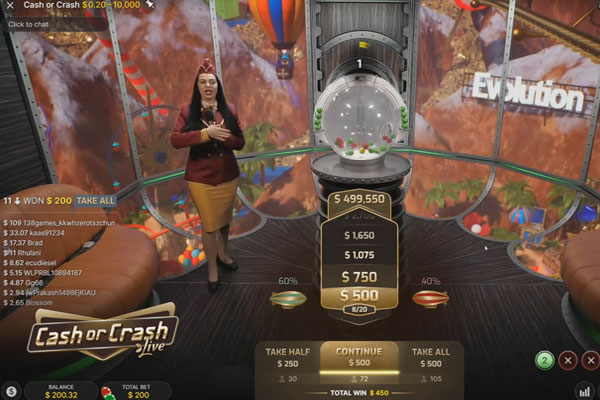


















Current Stats Accessible Cash or Crash Live Data

For participants involved in the Cash or Crash Live game show, the ability to view real-time and historical data is not merely a nice-to-have; it forms a fundamental part of informed participation https://cashorcrash.ca. We observe a rising desire among players for open, easy-to-find statistics that go beyond the instant rush of the broadcast. This data helps explain the game’s mechanics, enabling a more analytical method to playing. By analyzing trends in multiplier advancement, crash points, and round outcomes, players can frame their experience within a broader structure of apparent trends. This article examines the precise categories of live statistics available, their useful interpretation, and how they can guide a participant’s comprehension of the game’s flow, all while maintaining a clear-eyed view on the inherent randomness of each live event.
Future Trends in Live Game Data Analytics

In the future, we foresee that the role of live data in interactive game shows will keep increasing. Potential developments include more personalized data dashboards, allowing participants to track their own session history across multiple viewings. There could also be incorporation of broader statistical context, such as how the current session stacks up against aggregate data from thousands of previous games, further underscoring the long-term norms. Progress in data visualization will likely make trends more readily comprehensible at a glance. However, the core principle will remain: these tools are meant to enrich the experience and affirm transparency, not to offer an edge in predicting random events. The evolution will be aimed at greater clarity and user empowerment within the defined boundaries of chance-based entertainment.
Utilizing Data for Informed Participation Strategy
Because prediction is impossible, how then can live data be beneficial? We propose that its main utility lies in bankroll management and emotional regulation. By analyzing session volatility through historical crash points, a participant can take more informed decisions about the size and frequency of their engagement in relation to their personal limits. For example, a session showing high volatility with frequent early crashes might encourage a more conservative approach. Moreover, data can help set realistic personal goals; observing the historical high multiplier can serve as a benchmark, however unrepeatable. The strategy becomes about managing one’s own actions in response to an observable environment, not about beating the random number generator. This constitutes a shift from superstitious play to disciplined participation.
Interpreting Data While Avoiding Falling for Fallacies
This is arguably the most important section for every analytical participant. The human brain is proficient in finding patterns, even in completely random sequences—a cognitive bias referred to as apophenia. We must strictly guard against the gambler’s fallacy, which is the mistaken belief that past independent events affect future ones. In Cash or Crash Live, the random number generator resets for each round. A streak of five low multipliers does not indicate a high multiplier “due”; the probability for the next round remains unchanged. On the other hand, the hot-hand fallacy—believing a trend will continue—is just as misleading. Data interpretation should therefore focus on comprehending the game’s verified fairness and intrinsic randomness, instead of crafting predictive models. The statistics affirm the game’s integrity by demonstrating outcomes distributed in a manner aligned with its published probability profile, not by offering a crystal ball.
Separating Between Probability and Prediction
We maintain a clear line between probability and prediction. Probability is a mathematical concept derived from the game’s design; for example, the theoretical chance of the multiplier reaching a certain value before crashing. This is a fixed property of the game mechanics. A prediction, however, is a guess about a certain future outcome. Live statistics can inform a player about the broad probability landscape they are interacting with, but they cannot and must not be used to make particular predictions about the next crash point. A strong grasp of this distinction prevents the misuse of data and fosters a more balanced, more grounded approach to participation. The data informs us what *has* happened and demonstrates the *general* rules of the game, instead of what *will* happen next.
Grasping Live Data in Interactive Environments
The idea of live data in interactive entertainment refers to the continuous stream of information produced during a game session, presented to the audience with minimal delay. In the context of a game like Cash or Crash Live, this covers a wide array of metrics, from the current multiplier value rising in real-time to the aggregate results of previous rounds within the same session. We regard this transparency a significant development in the genre, connecting the gap between passive viewing and informed participation. The availability of such data changes the viewing experience into an analytical exercise, where each decision can be considered against a backdrop of recent history. It is vital, however, to differentiate between descriptive statistics, which describe what has happened, and predictive analytics, which try to forecast future events. The former is a instrument for informed awareness; the latter is often a misconception in games of chance, a difference we will explore in depth.
The Function of Real-Time Multiplier Tracking
At the core of the live data feed is the real-time multiplier tracker. This is the most direct and palpable statistic, visually representing the rising risk and prospective reward as a round progresses. We analyze this not just as a number, but as a core piece of the game’s narrative. Watching the speed of ascent, historical average crash points, and the behavior of the multiplier in the direct moments before a crash can give a sense of the game’s tension and rhythm. However, it is paramount to understand that this tracking is purely observational. Each multiplier path is decided by a random number generator at the moment the round begins, meaning its progression is independent of past rounds. The live tracking offers clarity into the outcome of that singular predetermined sequence, permitting players to witness the game’s fairness and randomness firsthand.
Historical Round Summaries and Play Aggregates
Enhancing the live tracker are comprehensive historical summaries. These typically outline the outcomes of the last 10, 20, or even 50 rounds, presenting the multiplier at which each round concluded (crashed). We analyze these aggregates to pinpoint session-wide characteristics, such as the volatility of a particular game session or the frequency of rounds reaching higher multiplier tiers. This macro view can shape a player’s general sense of the game’s current “temperature.” For instance, a session showing a cluster of early crashes might be regarded as highly volatile, while a session with several rounds surpassing a 10x multiplier might be seen as more generous. This historical data is valuable for setting personal expectations and managing one’s engagement strategy over the course of a viewing session, rather than for predicting the next specific outcome.
Key Statistical Metrics Frequently Accessible
In addition to the basic multiplier display, advanced data feeds often present calculated metrics. We commonly encounter statistics like the average crash multiplier for the session, the highest multiplier achieved, and the distribution of crashes across different multiplier ranges. Some displays may even show a live graph plotting each crash point, creating a visual histogram of recent outcomes. Another critical metric is the round count, which simply records the total number of rounds played in the ongoing session. This count highlights the continuous, episodic nature of the game. Comprehending what each metric represents is the first step toward meaningful interpretation. The average multiplier, for example, can be skewed dramatically by a single extremely high outcome, so it should be considered alongside the median or mode, if available, for a more balanced view of central tendency in that session’s results.
Summary
Live statistics for Cash or Crash Live present a notable layer of complexity to the player experience, turning it from a purely chance-based interaction to one that can be tackled with data-driven awareness. We have examined the types of data present, from real-time multipliers to historical aggregates, and emphasized the vital importance of understanding this information properly—understanding its descriptive, not prophetic, nature. The real value of this data lies in promoting transparency, facilitating informed personal bankroll management, and improving overall engagement by satisfying the audience’s fascination about game dynamics. By recognizing the constraints of statistics and the fundamental randomness of each round, participants can experience a more sophisticated and responsible interaction with the game, understanding the data as a component of modern interactive entertainment rather than a tactical oracle.
Comparing Data Accessibility On Platforms
The display and depth of live statistics can vary between different broadcasting platforms and service providers. We note that some might provide a minimalist display showing only the current multiplier and the last five crashes, while others provide extensive dashboards with graphs, running averages, and detailed round-by-round logs. The underlying game and its random outcomes remain consistent, but the accessibility and richness of the data layer differ. For the analytically minded participant, the choice of platform may be influenced by the quality and comprehensiveness of this statistical presentation. It is always wise to familiarize oneself with the specific data tools available on a given platform to fully understand what information is being presented and how frequently it is updated.
The Tech Powering Live Data Feeds
The smooth transmission of live statistics is a feat of modern streaming technology and backend systems. We recognize that this involves a complex architecture where game servers handle the random outcomes, create the multiplier curves, and then send this data via low-latency protocols to the viewing platform. This data is then processed and visually presented on the player’s screen through dynamic web interfaces or application programming interfaces (APIs). The emphasis is on speed and reliability to guarantee the data on screen is matched perfectly with the live video and audio feed. This technological backbone is what makes the transparent, data-rich experience possible, building an immersive environment where the participant feels directly connected to the game’s unfolding events with all relevant information at their fingertips.
Constraints and Responsible Use of Statistics
It is our responsibility to discuss the drawbacks of these statistical tools openly. First, live data is past and descriptive, not predictive. Second, data sets from a single gaming session, while informative, are relatively small samples and may not indicate the long-term statistical outcomes of the game. A session might appear “cold” or “hot” solely due to short-term fluctuation. Third, an over-reliance on statistics can foster a false sense of command or skill in a context fundamentally governed by chance. The appropriate use of this information involves appreciating it as a feature that improves transparency and participation, while at the same time acknowledging the core chance of each round. Data should shape a style of play, not determine expectations of specific results.